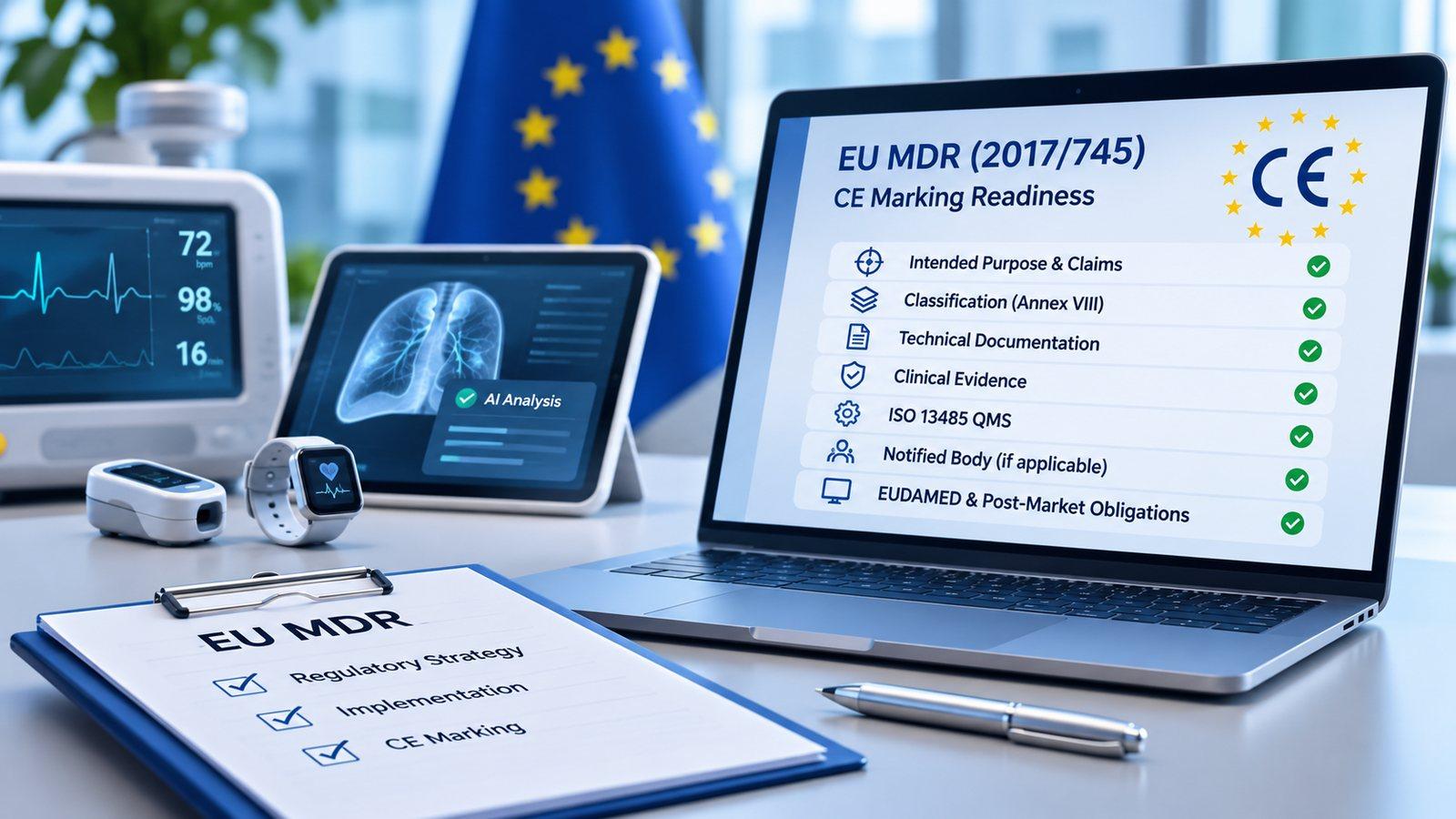
CE marking: what to establish first
- Confirm your device's intended purpose, claims and classification.
- Identify whether notified body involvement is required.
- Map technical documentation, clinical evidence and ISO 13485 QMS gaps.
- Plan EUDAMED obligations, timelines and post-market responsibilities.
CE marking under the EU Medical Device Regulation (MDR) is not simply a final step before a product launch. It is the outcome of a structured conformity assessment through which a manufacturer demonstrates that its medical device meets the applicable safety, performance and regulatory requirements for the European market.
For manufacturers developing medical devices and medical device software, the groundwork starts much earlier. The intended purpose, risk classification, clinical evidence, technical documentation and quality management system must all describe and support the same product. When these elements are developed separately, inconsistencies often appear late in the project, creating avoidable questions, additional testing and delays.
This guide explains seven essential steps in the EU MDR CE marking process, including the practical decisions that can influence certification timelines and market readiness.
1. Confirm the intended purpose and the applicable regulatory framework
Every credible CE marking strategy starts with the manufacturer's intended purpose. Before selecting a risk class or contacting a notified body, define what the product does, who will use it, the target patient population, the intended clinical setting and how the output is expected to support a medical decision or procedure.
The intended purpose is not determined by a single sentence in a regulatory document. It must be consistent with the product's actual functionality, instructions for use, website, sales materials and clinical evidence. A claim introduced in a marketing presentation can create an expectation that the classification rationale or available evidence does not support.
Consider medical imaging software designed to identify scans requiring urgent clinical review. A technical test showing that images are transferred accurately is valuable, but it does not demonstrate how reliably the software identifies urgent cases. If prioritisation is part of the intended medical purpose, the evidence strategy must address that claimed performance, including the consequences of incorrect outputs.
Medical device software, including some AI-enabled applications, should first be assessed for qualification under Regulation (EU) 2017/745. Software used for an in vitro diagnostic purpose may instead fall within Regulation (EU) 2017/746 (IVDR). These frameworks have different classification and conformity assessment requirements. The latest relevant MDCG guidance should be considered when documenting software qualification and classification.
2. Classify the device and determine whether a notified body is required
Once the intended purpose is established, classify the device using the rules in Annex VIII of the EU MDR. Devices are assigned to Class I, IIa, IIb or III, with the applicable rule and the rationale for the decision recorded in the technical documentation. For many medical device software products, Rule 11 is particularly relevant, although the complete set of applicable rules must be considered.
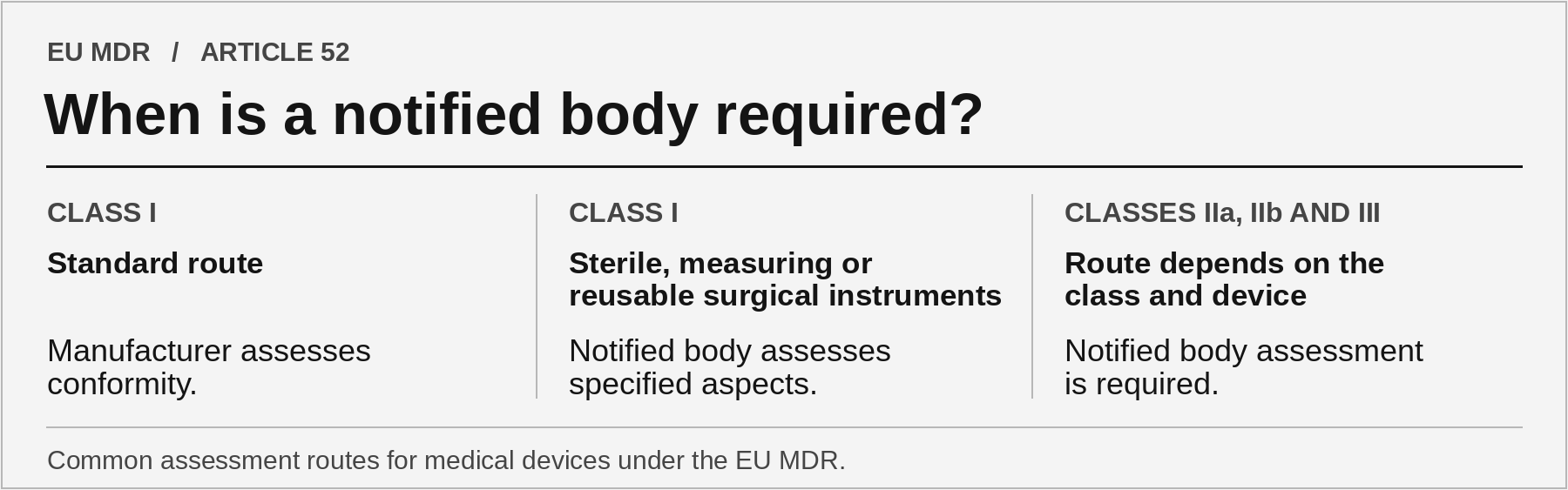
The classification directly affects the conformity assessment route under Article 52:
- Standard Class I devices can generally follow a manufacturer-led conformity assessment without routine notified body involvement.
- Class I devices supplied sterile, with a measuring function or as reusable surgical instruments require a notified body to assess the specific aspects relevant to those characteristics.
- Devices in Classes IIa, IIb and III require notified body involvement, with the scope and depth of assessment depending on the device and procedure.
A common planning mistake is to treat all CE marking projects as if they follow the same certification pathway. They do not. The work needed for a standard Class I device differs significantly from the assessment required for higher-risk devices or software subject to notified body review.
If a notified body is required, identify potential organisations early and verify their designation and scope in the European Commission's NANDO information system. A notified body may be designated under the MDR without covering every device type or conformity assessment activity. A productive initial discussion therefore includes a concise device description, intended purpose, proposed classification and the expected assessment route.
3. Build technical documentation that demonstrates conformity
EU MDR technical documentation should allow an independent reviewer to understand the device, evaluate the manufacturer's regulatory rationale and follow the evidence supporting safety and performance. It is not enough to collect reports in a folder if their relationship to the marketed product remains unclear.
Annex II sets out the principal technical documentation requirements, while Annex III addresses technical documentation on post-market surveillance. A well-organised file typically brings together the device description and specifications, intended purpose, labelling and instructions for use, design and manufacturing information, risk management, clinical evaluation and applicable verification and validation results.
An effective starting point is a traceable assessment against the General Safety and Performance Requirements (GSPRs) in Annex I. For each applicable requirement, the documentation should identify the method used to demonstrate conformity and the evidence that supports it. Where a requirement is considered not applicable, the rationale should be documented rather than left unexplained.
Traceability is especially important for software and AI-enabled products. Each report should make clear which software version, model configuration, dataset or device configuration it addresses, as relevant to the claimed performance. Evidence generated for an earlier release should not automatically be assumed to support a later version without a documented impact assessment.
A practical internal test is to select three important claims from the proposed instructions for use. Ask a colleague who did not prepare the file to trace each claim to the applicable requirement, risk control and supporting evidence. If the rationale cannot be reconstructed without verbal explanations from the original author, the documentation may need further work.
4. Develop clinical evidence that supports the intended purpose
Clinical evaluation is not a document prepared only at the end of development. Under Article 61 and Annex XIV of the EU MDR, it is an ongoing process for assessing the clinical data and evidence relevant to the device's safety, performance and benefit-risk profile.
The type and extent of clinical evidence depend on the device, its intended purpose, risk profile and the regulatory pathway. Existing clinical data, literature and clinical investigations may contribute where appropriate and adequately justified. The manufacturer must demonstrate that the evidence is relevant, sufficient and representative of the product it intends to market.
For software that prioritises medical images, for example, the central question is not only whether the algorithm runs as designed. It is whether the evidence supports the claimed clinical function in the intended population and use environment. The evaluation may need to consider missed cases, incorrect prioritisation, reference standards, relevant performance measures and the effect of the output on the clinical workflow.
Clinical evaluation, risk management and verification or validation activities should inform one another. A performance limitation identified during testing may affect a risk control, a user instruction or a proposed claim. Keeping these workstreams connected helps prevent gaps from being discovered only when the technical documentation reaches an external reviewer.
Post-market clinical follow-up (PMCF) should also be considered as part of the clinical evaluation strategy. Where PMCF is not appropriate, the manufacturer should document a suitable justification in accordance with the applicable MDR requirements.
5. Establish an MDR-aligned quality management system
The EU MDR requires manufacturers to establish and maintain a quality management system proportionate to the risk class and type of device. Article 10(9) covers responsibilities extending across the product lifecycle, including regulatory strategy, design and development, supplier management, risk management, clinical evaluation, post-market surveillance, vigilance and corrective action.
ISO 13485 is widely used to structure these activities and may form an important part of a manufacturer's readiness strategy. However, an ISO 13485 certificate does not replace the product-specific requirements of the MDR, and ISO 13485 certification is not a universal legal prerequisite for CE marking every device.
A functioning QMS should make regulatory decisions reproducible. If a software change affects an algorithm, clinical output or risk control, the team should be able to show what changed, who assessed its impact, which evidence was updated and who authorised the release. The same expectation applies to supplier changes, design modifications, complaints, nonconformities and corrective and preventive actions (CAPA).
Manufacturers should also establish clear regulatory responsibilities, including arrangements for the person responsible for regulatory compliance (PRRC) under Article 15, where applicable. Preparing procedures is only the starting point; implementation records, staff competence and internal audits help demonstrate that the system works in practice.
6. Complete conformity assessment and prepare for EU market entry
Once the relevant evidence and QMS controls are in place, the manufacturer must complete the applicable conformity assessment procedure. For devices requiring notified body involvement, this includes the relevant independent assessment and certification activities. For a standard Class I device, the manufacturer normally completes the appropriate assessment and declaration process without routine notified body review.
The notified body's certificate, where required, is not the CE mark itself. The manufacturer remains responsible for drawing up the EU declaration of conformity under Article 19 and affixing the CE marking under Article 20 once the applicable requirements have been met. The notified body's identification number accompanies the CE marking where the legislation requires it.
Market-entry planning should also cover the practical obligations that can be missed when the team focuses only on certification: the final intended purpose and labelling, instructions for use and required language versions, unique device identification (UDI), applicable economic operator arrangements, and any necessary EU authorised representative for a manufacturer established outside the European Union.
EUDAMED obligations should be assessed before launch. Since 28 May 2026, four EUDAMED modules have been mandatory to use: Actor Registration, UDI/Device Registration, Notified Bodies and Certificates, and Market Surveillance. The detailed responsibilities and transition arrangements depend on the economic operator, device status and applicable provisions. Registration should therefore be planned against the manufacturer's actual obligations rather than treated as a single administrative task at the end.
7. Plan post-market surveillance before the CE mark is affixed
CE marking is a milestone, not the end of the manufacturer's regulatory responsibilities. The MDR requires a post-market surveillance (PMS) system that actively gathers and reviews information on device safety and performance after market entry. The outcome should feed back into risk management, clinical evaluation, product changes and corrective action when needed.
The PMS plan should specify how complaints, user feedback, relevant literature, performance information and other sources are collected and assessed. Manufacturers also need processes for vigilance reporting, trend analysis and field safety corrective actions where applicable. The documentation and reporting outputs vary by device class, including PMS reports or periodic safety update reports as required.
For medical device software, post-market activities should also account for version changes, emerging cybersecurity concerns, real-world performance and any changes that could affect the continued validity of existing clinical evidence. Assigning responsibilities, data sources and review intervals before launch makes these obligations easier to manage throughout the product lifecycle.
What can delay CE marking under the EU MDR?
There is no single reliable timeline that applies to every medical device. A product's classification, testing needs, clinical evidence, QMS maturity, technical documentation quality and the availability and scope of a notified body can all influence the schedule. The most significant delays often occur where one activity depends on evidence that another team has not yet produced.
For example, a clinical claim may need to be narrowed because the data do not support the originally proposed use. That change can affect the intended purpose, instructions for use, risk assessment and sometimes the classification rationale. Similarly, an incomplete software configuration history can make it difficult to establish whether a verification report supports the final marketed version.
A realistic project plan identifies these dependencies early. Rather than setting a launch date first and working backwards without evidence, define the outstanding regulatory decisions, the documents and tests required to close them, the responsible owners and any external review steps. This produces a more credible forecast and helps the team prioritise work that genuinely affects market readiness.
An EU MDR readiness checklist for manufacturers
Before finalising your conformity assessment plan, confirm that your team can answer the following questions:
- Is the intended purpose consistent across the product, instructions for use, marketing claims and clinical evidence?
- Has the device qualification and classification rationale been documented against the correct regulatory framework?
- Can a reviewer trace applicable GSPRs to risk controls and supporting technical or clinical evidence?
- Does the QMS demonstrate implemented controls, not just approved procedures?
- Are the notified body route, economic operator arrangements, UDI and EUDAMED obligations understood?
- Are post-market surveillance, vigilance and clinical follow-up responsibilities assigned before launch?
If several answers depend on assumptions or evidence that cannot readily be retrieved, a focused regulatory gap assessment can be more valuable than progressing directly to the next submission milestone.
How Compliance MedQRA supports EU MDR readiness
At Compliance MedQRA, our regulatory and quality support is built around the decisions that determine whether a medical device is genuinely ready for the European market. We work with medical device manufacturers and medical software teams on device qualification and classification, conformity assessment strategy, technical documentation, clinical evidence planning and ISO 13485 quality management system implementation.
An effective readiness review should do more than identify missing documents. It should establish whether the proposed claims, regulatory pathway and available evidence are aligned; which gaps present the greatest risk to the project; and what sequence of actions will move the product towards a defensible conformity assessment. This practical approach helps teams focus resources on the issues that matter most before engaging a notified body or finalising a launch plan.
If you are preparing for CE marking, share your intended purpose, proposed device class, current technical or clinical evidence and target market-entry timeline. We can help you assess your regulatory position and identify the most useful next steps.
Frequently asked questions about EU MDR CE marking
How do I obtain CE marking for a medical device in Europe?
First establish the intended purpose and confirm which EU regulation applies. Then classify the device, identify the required conformity assessment route, compile the technical and clinical evidence, establish an appropriate QMS and complete the applicable assessment. The manufacturer issues the EU declaration of conformity and affixes the CE mark once the relevant requirements are satisfied.
Does every medical device need a notified body for CE marking?
No. Standard Class I devices can generally be assessed by the manufacturer. Notified body involvement is required for Class IIa, IIb and III devices and for specified aspects of Class I devices supplied sterile, with a measuring function or as reusable surgical instruments. The applicable scope follows the device and its conformity assessment route.
Is ISO 13485 certification mandatory for CE marking under the EU MDR?
The MDR requires an appropriate QMS, but third-party ISO 13485 certification is not a universal standalone legal prerequisite for every device. ISO 13485 is an important framework for QMS implementation, and notified body assessments may evaluate related processes as part of the applicable conformity assessment.
How is medical device software classified under the EU MDR?
Classification depends on the intended medical purpose and the Annex VIII rules. Rule 11 is particularly important for many software products that provide information for diagnostic or therapeutic decisions, but a software product should not be assigned a class on the basis of technology alone. Qualification and classification should be documented with reference to current MDCG guidance.
How long does CE marking take under the EU MDR?
There is no fixed duration suitable for every product. Timing depends on the device class, readiness of the technical documentation and clinical evidence, maturity of the QMS, testing needs and notified body availability where applicable. A meaningful estimate requires an assessment of the product's actual gaps and dependencies.
Is EUDAMED mandatory in 2026?
Yes, four EUDAMED modules became mandatory to use from 28 May 2026. However, specific registration responsibilities and transitional deadlines depend on the economic operator and device status. Manufacturers should check the European Commission's current EUDAMED guidance when defining their registration plan.
Regulatory references and further reading
Planning medical device CE marking?
Share your intended purpose, target market, current evidence and launch priorities. Our regulatory team can help assess the most useful next step.
Discuss an EU MDR readiness review ↗This article provides general regulatory information and does not replace a product-specific assessment of the applicable legislation and guidance.
.jpeg)